
How to Choose Diamond Bracelets: A Complete Buying Guide
Choosing a diamond bracelet is a different decision to choosing a diamond ring or earrings, and understanding why makes the purchase significantly easier. The short answer: identify the bracelet format that suits how you actually live, prioritise cut quality and stone consistency over total carat weight, buy certified for any principal stone above 0.5ct, and buy from a designer whose setting craftsmanship you can inspect and verify. The rest of this guide explains how to apply those principles to each bracelet type, and what the market does that customers should be aware of before they spend.
Diamond bracelets sit at the more demanding end of the fine jewellery wear spectrum. Unlike earrings, which receive minimal surface contact, or necklaces, which rest against fabric, a bracelet is in consistent motion and frequent contact throughout the day, with surfaces, with other jewellery, with everything a wrist encounters. That wear context makes the setting quality and structural integrity of a diamond bracelet more consequential than for almost any other piece type. A well-made diamond bracelet is an exceptional everyday piece. A poorly-made one becomes a liability.
For a full account of the four Cs - cut, colour, clarity, carat - and the mined versus lab-grown question in depth, the diamond knowledge guide covers both. If you want that foundation first, start there. If you are ready to make a decision, start here.
What to Look For in Diamond Bracelets
Setting quality before stone grade:
For diamond bracelets, the hierarchy of quality considerations is different to most other jewellery types. Cut grade remains important - it always is - but in a bracelet where multiple smaller stones are set across an articulated or rigid structure, the craftsmanship of the setting itself determines whether the piece remains wearable and secure over years of use.
A beautifully graded stone in a poorly-made setting will not remain in that setting. This is the primary thing to understand about diamond bracelets before any other quality decision.
The GIA (Gemological Institute of America) cut scale, Excellent down to Poor, applies to individual stones; for bracelet pieces featuring many small stones, the relevant quality signal is the consistency and evenness of the work across the entire piece. Look for stones that sit at a uniform level, are matched in apparent colour and size, and show no visible gaps or irregularity in the metal work between them.
Stone consistency across the piece
A diamond tennis bracelet — a single continuous line of matched stones set in an articulated metal strip — lives or dies on the consistency of its stones. Colour, clarity, and size should be visually uniform from end to end. Any visible variation — a stone that appears yellower, larger, or set at a slightly different angle to its neighbours — is a sign that stone selection was not done carefully. Reputable independent designers match stones with deliberate attention; volume production does not always apply the same standard.
Three things to check about the chain:
- Stone consistency across the full length - colour and size matched
- Setting level s-tones should sit uniformly, not at varying heights
- Clasp quality and security mechanism - this is where most bracelet failures occur
Certified stones for principal settings
For bracelets featuring a principal diamond - a solitaire bangle or a bracelet with one focal stone above 0.5ct - that stone should carry a certificate from GIA, IGI (International Gemological Institute), or AGS (American Gem Society). For tennis bracelets and pavé bangles where many small stones are used, individual stone certificates are not standard practice — consistent with how the wider diamond market handles small stones in multi-stone settings. Ask whether the designer can provide documentation on the stone source and quality range for the piece as a whole.
A note on GIA versus IGI: both use identical grading scales — D to Z for colour, FL (Flawless) to I3 (Included) for clarity, Excellent to Poor for cut. The practical difference is that IGI grades can run approximately one step more generously than GIA. An IGI G/VS2 and a GIA G/VS2 may not represent identical quality in the stone. Neither certificate is invalid — IGI is the dominant certification body for lab-grown diamonds and entirely standard in that context. What matters is that price comparisons across certified stones account for the certifying laboratory.
What to Ask Before You Buy
Ask about the clasp mechanism specifically. The clasp is the structural weak point of any bracelet. For a diamond tennis bracelet or a significant diamond bangle, ask whether there is a secondary safety catch in addition to the primary clasp — a box clasp with a figure-eight safety, or a fold-over clasp with a double lock. A bracelet of real value should not depend on a single closure point.
Ask whether the diamonds are mined or lab-grown. Both are sold through The Jewellery Room with full transparency. The answer should be consistent with any certification. Any seller who is reluctant to answer this directly is worth approaching with caution.
Ask about the metal — specifically whether it is solid gold and what purity. Is it 18k gold or 14k? Is it solid throughout or gold-plated? For a bracelet — the most wear-intensive jewellery format — this matters more than for a necklace or pendant. A gold-plated bracelet will show wear at contact points significantly faster than solid gold.
Ask about the articulation of the piece. A tennis bracelet or any multi-section bracelet relies on links or hinges between its sections. Ask whether the links are soldered closed or open — open links can catch and pull apart over time. Ask how the designer approaches the flexibility of the bracelet; it should move freely with the wrist without pulling tight or buckling.
Ask about stone treatments. Standard mined and lab-grown diamonds are not routinely treated. Some lower-quality mined diamonds, however, are fracture-filled or laser-drilled to improve apparent clarity — treatments that affect both durability and value. A certificate will note any treatment. Ask explicitly for any stone without a certificate.
What to Watch Out For
Total carat weight marketed as the primary quality signal. The bracelet market — particularly at the accessible end — frequently leads with total carat weight: "5ct diamond tennis bracelet." Total carat weight across many small stones tells a customer very little about how the piece actually looks. A bracelet set with fifty poorly-cut stones at 5ct total will look significantly flatter than one set with thirty well-cut stones at 3ct. Ask about cut grade and stone size consistency before total carat weight.
Weak or single-point clasp mechanisms. A diamond tennis bracelet with a value of several hundred pounds or more should have a clasp mechanism with a secondary safety catch. Clasps on fine bracelets can and do open unexpectedly — particularly box clasps that have been worn repeatedly without the safety catch being engaged. This is a real market failure, not a theoretical one. Inspect the clasp before purchasing, or ask the designer specifically about it.
GIA versus IGI — accounting for the difference. Customers comparing prices across certified stones should note which laboratory issued each certificate. An IGI G/VS2 and a GIA G/VS2 may represent slightly different quality. This is not a reason to distrust IGI certificates — it is a reason to compare like-for-like and factor in the lab when the grades and prices seem inconsistent.
Plated metal sold as gold. A bracelet worn daily will show wear at its highest-contact points — the underside of the wrist, the clasp, the link edges — faster than almost any other jewellery type. Gold plating over base metal will wear through at these points relatively quickly. Confirm you are buying solid precious metal — 18k gold, 14k gold, sterling silver, or platinum — not a plated base.
Misrepresented flexibility and wearability. Some rigidly-set diamond bangles are marketed for everyday wear when their setting makes daily contact a real risk to the stones. Bezel-set stones are significantly more appropriate for an everyday bangle than prong-set stones in a rigid format — the prongs of a hard bangle receive direct impact from surfaces in a way that an articulated tennis bracelet does not. Ask specifically how the designer recommends the piece be worn.
Diamond Bracelet Types — What to Consider for Each
Diamond tennis bracelets
The tennis bracelet — a single continuous line of matched diamonds set in an articulated metal strip — is the defining diamond bracelet format. The name originates from a real incident: tennis player Chris Evert stopped a match in 1987 to search for her diamond bracelet after the clasp opened on court. The story inadvertently named an entire category, and also illustrates the primary practical concern: clasp security.
For a diamond tennis bracelet, the quality considerations are: stone consistency across the full length (the most important visual quality factor), cut grade of the individual stones (round brilliant is the standard and the most efficient use of light in this format), and the clasp mechanism. A box clasp with a figure-eight safety is the conventional standard for fine tennis bracelets. A piece of meaningful value should have a secondary safety catch without exception.
Three things that matter for tennis bracelets:
- Stone consistency end to end — colour, clarity, and size matched
- Clasp mechanism with secondary safety catch
- Articulation quality — the bracelet should flex freely with the wrist without pulling
Diamond chain bracelets with accents
Diamond chain bracelets — fine chains in gold or platinum with diamond accents at intervals — are among the most wearable diamond bracelet formats for everyday use. The stones are typically set in small bezel or prong stations along the chain, and the articulated nature of the chain absorbs the movement and contact of daily wear more forgivingly than a rigid setting.
For this format, the quality considerations shift toward the chain itself: the link quality, the weight of the metal, and whether the chain is solid or hollow. A hollow chain will compress and kink under consistent daily wear in a way that a solid chain will not. Ask specifically.
Three things that matter for chain bracelets:
- Chain construction — solid links hold better than hollow under daily wear
- Stone setting security — bezel or channel settings are more durable than prong on a flexible chain
- Clasp quality — consistent with all bracelets, the clasp is the structural vulnerability
Diamond bangles
A bangle is a rigid, non-opening bracelet — it is slipped over the hand rather than clasped around the wrist. This distinction has a significant implication for diamond bangles: because the piece is rigid, the stones on its surface receive direct contact with hard surfaces in a way that an articulated bracelet does not. Setting choice matters considerably as a result.
Bezel-set stones — where the diamond is enclosed in a rim of metal — are the most appropriate setting for diamond bangles intended for regular wear. The bezel protects the stone from lateral impact. Prong-set diamonds on a rigid bangle are more dramatic in appearance, but the prongs are exposed to surfaces in a way that earring or pendant prongs are not — they catch, bend, and loosen more readily.
Some customers deliberately choose to wear a prong-set diamond bangle with the understanding that it is a piece for particular occasions rather than daily contact.
That is a reasonable choice when made knowingly. It becomes a problem when a prong-set bangle is purchased for daily wear without that context being clear.
Three things that matter for bangles:
- Setting type — bezel for daily wear, prong for occasional wear
- Bangle sizing — a bangle must pass over the knuckles; measure at the widest point of the hand, not the wrist
- Width and weight — wider bangles distribute pressure differently; heavier pieces in platinum or thick gold are more comfortable on some wrists than others
Pavé and diamond-set cuff bracelets
Cuff bracelets — wide, rigid bands that open at one side — set with pavé or channel diamonds are statement pieces. The pavé work quality is the primary consideration: stones should be set evenly, at a consistent level, with no visible gaps in the metal between them. Irregularity in pavé work becomes more visible on a wider surface than on a narrow band.
Cuffs, like all rigid bracelets, sit at the higher-maintenance end of the spectrum for daily wear — not because they are fragile, but because the open side of the cuff means the piece is put on and taken off by flexing, which places stress on the metal at the opening point over time. A fine diamond cuff is typically better suited to significant occasions and regular but not daily wear.
Why Choose an Independent Designer?
Stone selection is individual, not by specification. Volume producers source diamonds to a grade range; an independent designer who works with diamonds selects stones for the specific piece, based on how the stones actually look together in the setting they have made. For a diamond tennis bracelet — where the consistency of forty or more matched stones determines the quality of the piece — the difference between individually-selected stones and specification-bought stones is visible.
Structural decisions are made by someone with a stake in the outcome. The clasp mechanism, the articulation quality, the thickness of the metal in each link — these are decisions that a designer who builds their reputation piece by piece makes differently to a manufacturer optimising for unit cost. Independent makers build with the knowledge that the customer will be wearing the piece for years and will remember where it came from.
Transparency about materials is substantiated, not stated. An independent designer has a direct relationship with their supply chain. Conflict-free certification, lab-grown origin, recycled metal sourcing — these are commitments a maker can verify personally. This is different in character from the sourcing claims of large commercial operations.
The design reflects a point of view. Volume production makes what the market wants. Independent designers make what they believe the piece should be — which produces a different result. A diamond tennis bracelet from an independent maker may sit differently on the wrist, use an unexpected link width, or combine metals in a way that a commercial template would not. The individuality is a consequence of genuine design thinking, not a styling decision.
Why shop at The Jewellery Room?
The Jewellery Room is a curated marketplace for independent jewellery designers. Every designer on the platform has been selected by founders Charlotte and Pernille Møbjerg, who have spent decades in the jewellery industry and apply that experience to the curation. The Jewellery Room does not own the jewellery or control the individual sourcing practices of the designers it features — what it does is make considered decisions about which designers belong on the platform, and stand behind those decisions editorially.
For diamond bracelets specifically:
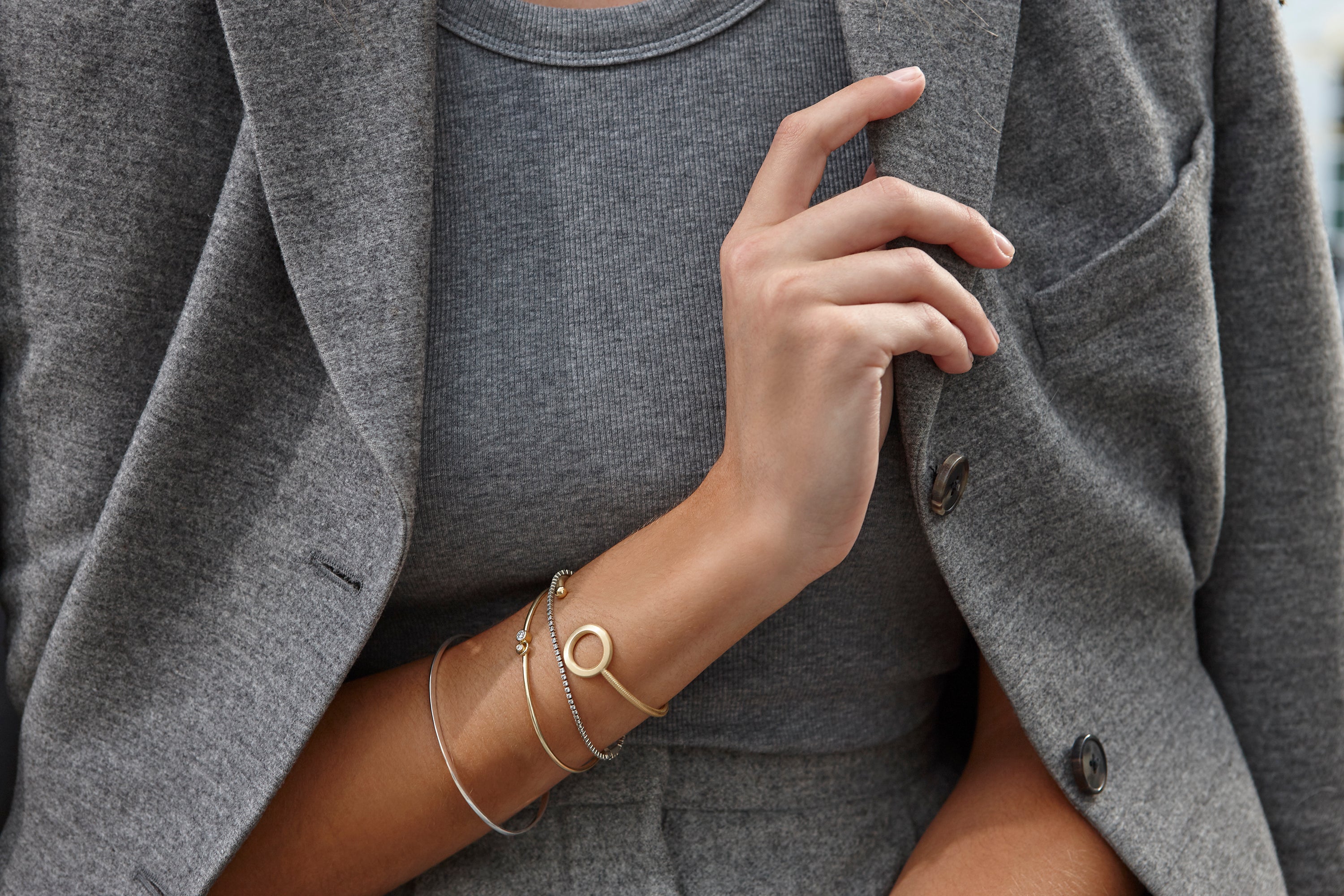
The selection covers the full range of formats. Tennis bracelets, diamond bangles, chain bracelets with accents, pavé cuffs — the complete range of what diamond bracelets can be, from designers who have each thought specifically about their own version of the format.
Mined and lab-grown are both represented with transparency. Designers featured on The Jewellery Room work with both mined diamonds — conflict-free certified — and lab-grown diamonds from verified sources. Both are presented with clarity about what each stone is and where it came from.
The price range is real. Accessible everyday diamond bracelets from independent designers working in 18k gold sit alongside significant investment pieces. The curatorial standard applies across the range.
Our Favourite Styles: Diamond Bracelets at The Jewellery Room
Diamond Tennis Bracelets - The defining diamond bracelet format, from independent designers who approach its structure with their own point of view on stone selection, link design, and clasp engineering.
Browse Diamond bracelets →
Diamond Bangles - The defining diamond bracelet format, from independent designers who approach its structure with their own point of view on stone selection, link design, and clasp engineering.
Browse Diamond Bangles→
Solitaire Diamond Bracelets - A subtle and elegant bracelet style that will capture attention every day - at work or at the party!
Browse Diamond Jewellery→
Selected Designers for Diamond Bracelets
VRAI - VRAI's pieces are set in 14k gold with lab-grown diamonds produced in their own zero-emission facility, powered by renewable energy. Stunning pieces that do good for the world - we love the bracelets especially!
Browse VRAI →
Le Soonar — Founded in Copenhagen in 2021 by best friends and creative spirits Vidhi Jain and Shivangi Jhalani, Le Soonar is a brand grounded in the timeless traditions of Indian jewellery and the allure of diamonds and precious gemstones.
Browse Le Soonar →
Alexa Fine Jewellery — Alexa Fine Jewellery is founded by siblings Alex and Elena, and born from a wish to create affordable luxury jewellery. Coming from a family of jewellery makers, Elena uses the wealth of knowledge she’s picked up from childhood when designing each piece, all crafted in 18K gold.
Browse Alexa Fine Jewellery→
Whatever the budget, allocate it to setting quality and stone consistency before total carat weight. A well-made tennis bracelet with consistently matched stones at a moderate total carat weight will outlast and outperform a heavier piece with inconsistent stones and a weak clasp. For a diamond bracelet worn daily — which is the real test of value — structural integrity is the quality factor that determines whether the purchase was worthwhile five years from now.
For daily wear, the most practical formats are the diamond tennis bracelet and the diamond chain bracelet with accent stones. Both are articulated rather than rigid, which means they move with the wrist rather than pressing against it. For both, the clasp mechanism is the critical quality point — a secondary safety catch is advisable for any piece of meaningful value. Bezel or channel settings are more durable for daily contact than prong settings in any bracelet format.
Ask about the clasp mechanism — specifically whether there is a secondary safety catch. Ask whether the stones are mined or lab-grown, and whether any principal stone above 0.5ct carries a GIA, IGI, or AGS certificate. Ask whether the metal is solid gold throughout or plated — for a bracelet worn daily, this affects how the piece ages. Ask about articulation: whether the links are soldered and how the bracelet moves. These are reasonable questions; any reputable designer or seller will answer them without hesitation.
Independent designers make structural decisions — clasp mechanism, link quality, stone selection — with the knowledge that their reputation depends on each individual piece. They select stones personally, not by grade specification alone, which matters particularly for multi-stone pieces where consistency is the primary quality signal. Their supply chain relationships are direct and verifiable in a way that large commercial operations typically are not. For a customer who will wear the piece daily and expects it to last, those differences are meaningful.
A tennis bracelet is articulated — it is made of linked sections and a clasp, and flexes freely with the wrist. A bangle is rigid — it has no clasp and is slipped over the hand. The practical difference for diamond settings is significant: an articulated tennis bracelet absorbs movement and absorbs impact more forgivingly; a rigid bangle transmits surface contact directly to the stones. For daily wear, tennis bracelets are generally more forgiving. For customers who prefer the simplicity of no clasp, a bezel-set diamond bangle is the more practical choice within the bangle format.
For a full account of the four quality factors, the mined versus lab-grown question in depth, and what each diamond shape offers, see our diamond knowledge guide.
For detailed guides on each quality factor: diamond cut · diamond colour · diamond clarity · diamond carat
