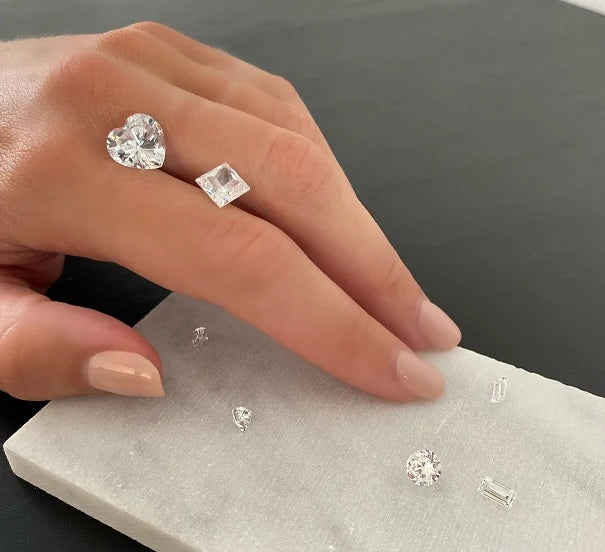
Diamonds: The Complete Guide
Of the four precious stones — diamond, ruby, sapphire, emerald — diamond is the one buyers understand least well, despite being the most widely purchased. Not because it is complicated. Because the conversation around it has been dominated for so long by a single number: the carat weight. Ask most people what makes a diamond valuable and they will say size. They are not wrong — carat weight matters. But it is the last thing that should drive a decision, not the first.
The buyers who get the most from a diamond budget are the ones who understand that a smaller, well-cut stone in the right colour and clarity range will look more compelling than a larger stone with poor light performance. This guide explains how to make that judgment confidently.
What is a diamond?
Diamond is a mineral — pure carbon atoms arranged in a cubic crystal structure, formed deep in the earth's mantle under temperatures of approximately 1,050–1,300°C and pressures exceeding 45 kilobars. Most diamonds being mined today formed between one and three billion years ago. They reached the earth's surface through volcanic eruptions, carried in a rock type called kimberlite.
For a full gemological profile, see our Diamond Buying Guide.
Key facts at a glance:
- Mineral: pure crystalline carbon
- Hardness: 10 Mohs - the hardest natural material on earth
- Refractive index: the highest of any colourless stone — more light returns to the eye than with any other gem
- Clarity: almost always included at some level, though inclusions are rarely visible to the naked eye
- Primary sources: Botswana, Canada, Russia, South Africa, Australia, Democratic Republic of Congo
- Treatment: mined diamonds are not routinely treated; lab-grown diamonds are created through HPHT or CVD processes
Although rough diamond jewellery might be a desirable piece of jewellery for those who cherish the idea and beauty of the untouched diamond, a rough diamond is for most people an unimpressive stone. It’s dull, grey-brownish-looking, without obvious beauty. Its qualities only become visible to most after cutting and polishing. The cutter's entire purpose is to release the light trapped inside. How successfully they do that is the cut — and cut is everything.
Cut - the factor most buyers underestimate
Of the four quality factors, cut is what most determines whether a diamond looks beautiful. It is also the most frequently underweighted by buyers who focus on carat first.
The principle is straightforward. When a diamond's facets — its flat polished surfaces — are proportioned, aligned, and polished correctly, light that enters through the top of the stone reflects internally and exits back through the top as brilliance (white light return), fire (coloured light flashes), and scintillation (sparkle when the stone moves). When a diamond is cut too shallow or too deep, light leaks through the sides or base, and the stone appears flat and lifeless regardless of its other qualities.
Cut controls:
- How light enters
- How it bounces inside
- How it returns to your eye
The GIA, one of the world’s most respected diamond grading institutes (Gemological Institute of America) grades cut from Excellent through Very Good, Good, Fair, and Poor. A diamond of Excellent cut grade at G colour and VS2 clarity will look more compelling than a poorly-cut stone of D colour and VVS1 clarity. This is worth stating plainly because it inverts the instinct to spend upwards on colour and clarity while accepting a lower cut grade.
What cut grade means in practice:
Excellent is the right target for solitaires, stud earrings, and any piece where the diamond is the focal point.
Very Good is an acceptable step down for smaller accent stones where light performance is less critical.
Fair and Poor cut grades produce stones that look dull regardless of how their other qualities grade — avoid them.
Cut vs shape — these are different things:
Cut refers to the quality of the faceting: the proportions, symmetry, and polish that determine light performance. Shape refers to the external outline of the stone — round, oval, emerald, pear, and so on. A round diamond and an oval diamond can both receive Excellent cut grades. The cut grade tells you how well the stone handles light; the shape tells you what it looks like.
For a full explanation of cut grades, proportions, symmetry, and how to evaluate a diamond's light performance, see our Diamond Cut Guide.
Where do the finest diamonds come from?
For coloured gemstones, origin is one of the primary quality signals, Kashmir and Sri Lanka sapphires and Colombian emeralds command premiums because the geological conditions of those sources produce distinctive colour. For white diamonds, origin matters far less. The quality of any white diamond is determined by its four grading factors, not its address.
The world's largest producing countries are Botswana, Canada, Russia (Siberia), South Africa, the Democratic Republic of Congo, and Australia. Australian production has declined significantly since the Argyle mine closed in 2020 — the same mine that was historically the world's primary source of pink and red diamonds. In fact the Argyle mine accounted for around 90% of the world’s natural pink diamonds.
Where origin does matter is in two specific contexts. The first is fancy coloured diamonds: natural vivid pink diamonds from Argyle, now no longer in production, have become one of the most aggressively appreciating categories in fine jewellery. Natural blue diamonds from certain African sources are among the rarest and most valuable stones in the world. The second context is provenance documentation: for buyers concerned with ethical sourcing, what matters is conflict-free certification and a traceable supply chain, which are independent of country of origin.
What makes a diamond valuable?
The diamond industry uses four grading factors — Cut, Colour, Clarity, and Carat weight — standardised by the GIA and now the universal language of diamond quality. They are interconnected: decisions about one affect the others, and understanding their interaction is what separates an informed purchase from an instinctive one.
1. Cut
Covered above. No other factor compensates for poor cut. Prioritise this above everything else.
2. Colour
For white diamonds, a higher grade means less colour. The GIA scale runs from D (completely colourless) to Z (visibly light yellow or brown). D–F are colourless and command the highest premiums. G–J are near-colourless — any difference from D–F is invisible to the naked eye at normal viewing distance, at a considerably lower price point.
Metal choice interacts directly with colour. D–F stones are often set in white gold or platinum; in yellow gold, the metal's warmth reflects into the stone and makes even a colourless diamond appear slightly yellow, wasting the premium paid for that grade. However, gold type is a matter of taste and preference. G–J stones work in any metal. For step-cut shapes (emerald, Asscher), choose a higher colour grade — their large, open facets reveal colour that brilliant cuts conceal.
For a full breakdown of the GIA colour scale, fancy colour grading, and metal pairing, see our Diamond Colour Guide.
3. Clarity
Clarity refers to the presence or absence of internal characteristics (inclusions) and external characteristics (blemishes), assessed under 10× magnification by a trained grader. The GIA clarity scale runs from Flawless (no inclusions or blemishes visible under 10×) through Internally Flawless, VVS1/VVS2, VS1/VS2, SI1/SI2, to Included.
For most buyers, the practical range is VS2 to SI1: inclusions are not visible to the naked eye, and the price difference compared with VVS or Flawless grades is substantial with no visible benefit in daily wear. A VS2 stone of Excellent cut and good colour is a more compelling everyday piece than a VVS1 of inferior cut.
Clarity interacts with shape: step-cut diamonds (emerald, Asscher) show inclusions readily through their large open facets. For those shapes, move up to VS1 or higher. Round brilliants and cushion cuts handle inclusions best — their many facets scatter light and conceal internal characteristics effectively.
For a full explanation of the clarity scale, inclusion types, and how to balance clarity against budget, see our Diamond Clarity Guide.
4. Carat
Carat is the unit of weight: one carat equals 200 milligrams (0.2 grams). A diamond's carat weight tells you how much it weighs — not precisely how large it looks. Size does not scale linearly with weight, and different shapes distribute the same weight differently across the face-up surface.
Diamond prices increase significantly at certain carat thresholds — 0.50ct, 0.90ct, 1.0ct, 1.5ct, 2.0ct. Buying slightly below these magic numbers (0.93–0.95ct rather than 1.0ct) delivers equivalent appearance at meaningfully lower cost. In some cases, diamonds just under one carat are marketed and priced alongside full-carat stones, making the distinction more technical than practical.
One point worth stating clearly: diamond weight uses carat (ct). Gold purity uses karat (k or kt) — as in 18k gold. These are entirely unrelated measurements that sound similar. Do not conflate them.
For a full explanation of carat weight, size-to-carat relationships, and engagement ring carat guidance, see our Diamond Carat Guide.
Mined or lab-grown?
This is the most significant choice facing a customer buying diamond today. It deserves an honest account rather than a position.
Lab-grown diamonds are real diamonds.
Chemically, physically, and optically identical to mined stones — same carbon crystal structure, same hardness, same refractive index, same grading criteria. The GIA & IGI certifies lab-grown diamonds as genuine diamonds. The distinction is origin only.
How lab-grown diamonds are made
Two methods are used commercially. HPHT (High Pressure High Temperature) replicates the geological conditions of natural diamond formation: a diamond seed is placed in carbon under extreme pressure and temperature, and crystallises over days to weeks. CVD (Chemical Vapour Deposition) places a diamond seed in a carbon-rich gas chamber; carbon atoms deposit on the seed layer by layer. CVD now dominates gem-quality lab-grown production and typically produces larger, higher-clarity stones. Both methods produce genuine diamond material.
Price
Lab-grown diamonds currently cost 60–80% less than mined diamonds of equivalent grade. The price gap has widened as production has scaled. For a customer who values optical performance and size over geological origin, lab-grown offers access to a materially better stone within the same budget.
The resale value question - addressed honestly.
Lab-grown diamond prices have declined substantially as production has scaled, and resale value is currently very low compared to mined stones. For customers who regard jewellery as an investment or intend to pass pieces on as financial assets, this matters. For customers who intend to wear the piece — the majority of jewellery purchases — the lower acquisition price represents straightforward value for money.
Environmental considerations
Lab-grown diamonds require significantly less land disturbance than mining. However, energy demands in production are substantial. The sustainability case depends on whether the facility uses renewable energy. General "eco-diamond" positioning without specific production detail is worth scrutinising.
The framework
If geological origin and long-term value retention matter to you, choose a mined diamond. If optical quality, size for budget, and clear ethical provenance are the priorities, lab-grown is a compelling option. Both are valid. The choice depends on what you are buying the piece for.
For a direct comparison in the engagement ring context specifically, see natural vs lab-grown diamond engagement rings.
For a deeper look at lab-grown diamonds, including how to evaluate sustainability claims and certification, see our Lab-Grown Diamond Guide.
Is diamond a good choice for an engagement ring?
Yes — and the case for it is stronger than any other stone. But understanding exactly why helps make a better decision.
The case for a diamond engagement ring:
Diamond is the only gemstone rated 10 on the Mohs scale. It cannot be scratched by any other material in normal life — it can be cleaned, worn daily, knocked against surfaces, and washed without concern for surface damage. No other engagement ring stone offers that combination of hardness and durability.
Diamond's refractive index means it captures and returns light unlike any other colourless stone. A well-cut diamond reads as brilliant in any light condition — daylight, office light, candlelight — without needing to be positioned carefully to show its best. This is not a trivial point for a piece worn every day.
The round brilliant cut, designed specifically to maximise diamond's optical properties, produces a piece with universal legibility. The emerald cut, the oval, the cushion — each offers a distinct aesthetic at a lower price point than an equivalent round brilliant.
The honest context
Hardness means scratch resistance, In rare cases, a diamond can cleave or chip under a hard, direct impact, particularly at vulnerable points such as corners and tips. A diamond can cleave along crystal planes under a sharp direct blow, particularly at corners and points in fancy-cut shapes (princess, pear, marquise). In practice, however, this is not something typically encountered in everyday wear, and the overall risk remains low. Setting choice matters: pointed corners should be protected by prongs; a very active lifestyle warrants consideration of a bezel setting.
The setting is the vulnerability, not the stone. Prongs loosen over time — particularly with daily wear. Annual professional inspection is not optional; it is how a ring remains wearable for a lifetime.
For customers who want a stone that can be worn without special cleaning rules, without periodic treatment maintenance, and without meaningful concern for day-to-day damage — diamond is the correct choice. No other stone makes that case as cleanly.
How to care for diamond jewellery
Diamond is the most care-free of all gemstones, but it is not entirely maintenance-free. The stone requires minimal attention; the setting requires consistent care..
Cleaning:
- Mild soap and warm water with a soft brush — the standard cleaning method, effective and completely safe
- Ultrasonic cleaners are generally safe for diamonds set in gold or platinum — but check with the jeweller if the piece contains other stones, as pearls, emeralds, and opals will be damaged
- Steam cleaning is safe for plain diamond and gold pieces
- Clean regularly — diamonds attract grease faster than most stones, and a dirty diamond is often mistaken for a dull one
What to avoid:
- SSwimming — chlorine degrades metal alloys and can loosen settings over time; remove before entering pools or the sea
- Heavy exercise and contact sport — impact can shift a stone in its setting
- Sleeping in rings — prongs catch on fabric and bend gradually with repeated movement
- Perfume and hairspray applied directly to the stone — organic residue builds up and reduces light return
Storage:
- Store separately from other pieces — diamond will scratch softer gemstones
- A soft pouch or lined compartment is sufficient
Regular maintenance:
- Have fine diamond pieces professionally inspected annually — a trained eye can identify a loose prong before a stone is lost
- For engagement rings worn daily, this is not optional — it is how a ring remains wearable for decades
- White gold settings require rhodium re-plating every one to two years with regular wear if you like to maintain the shiny blank look; this is routine maintenance, not a defect
For a full guide to cleaning all jewellery types at home, including tools and techniques, see how to clean jewellery.
Shop diamond jewellery at The Jewellery Room
The Jewellery Room is a curated marketplace for independent jewellery designers, selected for the quality of their materials, the transparency of their sourcing, and the craft in their work. All diamond jewellery sold through The Jewellery Room comes from designers working with conflict-free diamonds; several work exclusively with lab-grown or recycled stones.
Diamond is pure carbon crystallised over billions of years under extreme heat and pressure in the earth's mantle. It is the hardest natural material on earth (10 Mohs) and has the highest refractive index of any colourless stone, returning more light to the eye than any other gem. Both mined and lab-grown diamonds are genuine diamonds — identical in chemical composition, crystal structure, hardness, and optical properties. The only difference between them is origin.
For white diamonds, geographic origin has limited bearing on quality — the four Cs determine value regardless of where the stone was mined. The major producing countries are Botswana, Canada, Russia, South Africa, and the Democratic Republic of Congo. Origin matters significantly for fancy coloured diamonds: natural vivid pinks from Australia's Argyle mine (now closed) and fine blue diamonds from certain African sources command substantial premiums. For customers focused on ethical provenance, conflict-free certification and traceable supply chains matter more than country of origin alone.
Standard mined diamonds are cut and polished — not treated in the way many coloured gemstones are. Lab-grown diamonds are produced through HPHT or CVD processes — these are manufacturing methods, not treatments applied to existing stones. A certificate from an independent laboratory will note any treatment applied to a stone.
Buy certified. A certificate from the GIA, IGI, or AGS confirms the four C grades independently of the seller. Within those grades, prioritise cut above all else — a well-cut diamond of G colour and VS2 clarity will look more compelling than a poorly-cut stone of D colour and VVS1 clarity. The practical target for most customers is Excellent or Ideal cut grade, G–H colour, VS2–SI1 clarity. Never compromise on cut in favour of higher grades in colour or clarity.
Chemically and physically, there is no difference — both are genuine diamonds. The distinction is origin, price, and resale value. Lab-grown diamonds currently cost 60–80% less than mined stones of equivalent grade. They carry significantly lower resale value as production has scaled rapidly. For buyers prioritising wearing value over investment, lab-grown offers access to a materially better stone for the same budget. For buyers who value geological origin or long-term value retention, mined diamonds are the choice. Both are valid positions — the right answer depends on what the piece is for.
Yes — and the strongest case of any gemstone. At 10 Mohs it is the only stone that can be worn daily without concern for surface scratching. Its refractive index means it performs in any light condition without careful positioning. The honest caveats are limited: diamond can chip under sharp direct impact at corners and points, so fancy-cut shapes (princess, pear, marquise) benefit from protective settings; and the setting itself requires annual professional inspection for loose prongs. For buyers who want a ring that requires no special cleaning rules and no treatment maintenance — diamond is the correct choice.
Clean regularly with mild soap, warm water, and a soft brush — diamonds attract grease, and a dirty stone is frequently mistaken for a dull one. Ultrasonic cleaners are safe for diamonds in gold or platinum settings. Remove pieces before swimming, heavy exercise, and sleep. The main ongoing care concern is the setting rather than the stone: have fine diamond pieces professionally checked annually for loose prongs, particularly engagement rings worn daily. White gold settings require rhodium re-plating every one to two years with regular wear — routine maintenance, not a defect.
All facts in this guide are cross-referenced against The Jewellery Room's internal Jewellery Knowledge Reference. For detailed guides on each quality factor, see our Diamond Cut Guide, Diamond Colour Guide, Diamond Clarity Guide, and Diamond Carat Guide.
Guide last updated: April 2026.