



Bergsøe: Everything you need to know about Aquamarines
By co-founder Charlotte Møbjerg
Everything you need to know about Aquamarine, according to Josephine Bergsøe
Aquamarine is one of the most magical gemstones, ranging from light blue to turquoise shades that might bring deep oceans, tropical beaches or salty swims to mind.
But it is also one of the most commonly misunderstood stone in fine jewellery. While many buyers looking for an aquamarine might know what they think they want - a perfectly clear, transparent blue - they often end up walking straight past the stones that are actually worth stopping for.
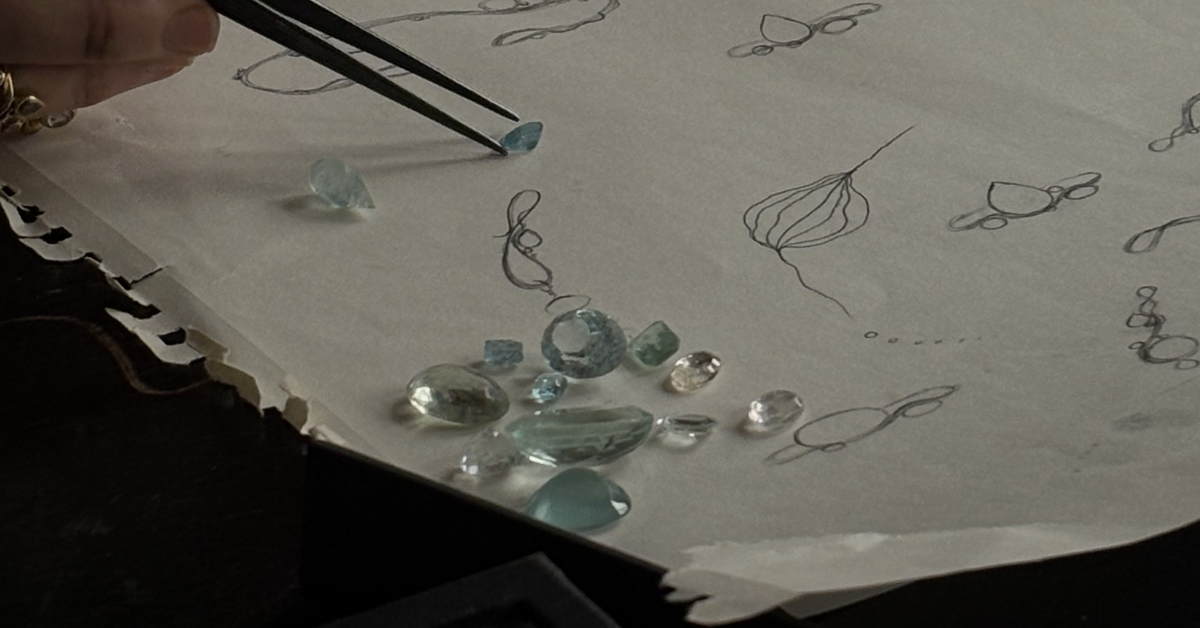
Josephine Bergsøe, the acclaimed goldsmith and artist behind jewellery brand Bergsøe, has spent decades working with aquamarines. We visited her in her studio in central Copenhagen, to hear her perspective on aquamarines, and what it really is that makes them so special.
"Many search for the perfectly clear, blue aquamarine, but I want the ones that are different"
Aquamarine belongs to the mineral family beryl - the same mineral as emerald.
"Aquamarine and emerald is actually the same stone" Josephine explains, "but while emeralds have that rich, green colour, aquamarines are lighter blue or even turquoise"
That shared origin is part of what makes aquamarine so interesting to work with: it carries the geological depth of one of the world's most celebrated gemstones, expressed in an entirely different palette.
The colour range is wider than most buyers realise. From the palest icy blue to a deep, saturated teal, aquamarine shifts dramatically depending on its origin, cut, and the light it is held in. But origin alone does not tell the full story.
Here is where Josephine's perspective diverges from conventional wisdom. The jewellery industry typically treats inclusions — the internal characteristics formed during a stone's growth — as flaws to be minimised. In aquamarine, and in its beryl cousin emerald, they are celebrated.
"For both emerald and aquamarine, the so-called inclusions make each stone unique," she says. "For other stones, these might be considered a fault, but for these stones, it's an additional quality. It's the only gemstone that I know of that is considered better for having faults. I think it's really beautiful."
That philosophy shapes how she selects stones. "Many search for the perfectly clear, transparent blue stone," she explains, "but I look for the ones that differ. They carry more of a story, through inclusions and structure, or a shade of aqua blue you've never seen before."
It is a meaningful reframe. An aquamarine with a distinctive internal landscape is not compromised, it is singular. No two stones with inclusions will ever look identical, which means the piece built around it cannot be replicated either.
If you are buying aquamarine, Josephine's approach offers a useful guide. She sources all her gemstones personally on trips and knows her suppliers and their process well, in order to always guarantee that things are done in ethical way.
Rather than searching for flawless clarity, Josephine says that she encourages you to consider what makes the individual stone alive, its particular shade, the way its inclusions catch the light, the sense that this stone has a character specific to itself.
"I'm fascinated by aquamarines," Josephine says. "They exist in so many shades and forms." Coming from a goldsmith who has spent her career in pursuit of the extraordinary, that fascination is recommendation enough.
Discover all Bergsøe Jewellery here.