
The Solid Gold Ring Buying Guide: Purity, Fit & Craftsmanship
Finding the ideal gold ring is an intimate journey that blends personal expression, aesthetics, and long-lasting value. Whether you are searching for an everyday staple or a statement piece to celebrate a milestone, a real gold ring offers a warm, radiant lustre years to come. Navigating the world of fine jewelry requires understanding karat purities, surface finishes, and design heritage. This buying guide walks you through every aspect of choosing real gold jewelry, ensuring your next piece remains a cherished treasure for generations.
The short answer
Three things decide whether a gold ring earns its price: purity, fit and honest craftmanship. An 18k gold ring gives you the richest colour and suits most everyday wear beautifully. A 9k gold ring trades a little of that depth of colour for real toughness, a genuinely good choice tf you seek maximum resilience for an active lifestyle. Choose solid gold over plated for anything you'll wear often, get the sizing right before you buy, and check for a proper hallmark for lasting value.
What to Look For
A ring worth buying tends to get four things right.
- Purity and hallmarking: a genuine hallmark confirms gold content (375 for 9k, 750 for 18k, 916 for 22k), rather than leaving you to take the seller's word for it.
- Weight and proportion: pick it up and it should feel balanced in the hand, not lopsided or hollow.
- Setting quality: on a gold diamond ring, look closely at the setting depth, how securely the prongs grip, and how cleanly the claws are finished.
- Metal tone: yellow, white and rose gold each suit different skin tones and different pieces already in your jewelry box, so think about what it'll sit alongside.
Understanding Gold Karats and Purity Standards
Gold purity is measured in karats, a simple ratio of pure gold to the other metals it's alloyed with, usually copper, silver or zinc. Pure 24k gold is beautiful, soft and malliable but unsuitable for intricate daily jewelry, especially a ring that gets knocked against desks and door frames all day. Alloying gold with harder metals is what makes a ring durable enough to actually live on your hand.
- 9k gold (37.5% pure): the toughest of the common purities, with a paler, softer yellow. A smart choice for a ring you never plan to take off.
- 14k gold (58.5% pure): a solid middle ground, still noticeably harder-wearing than 18k with a touch more warmth than 9k. A dependable choice if you want real gold colour without babying it.
- 18k gold (75% pure): the standard for fine jewelry across the UK and Europe. Deep, warm colour without giving up much strength.
- 22k gold (91.7% pure, hallmarked 916): rich and traditional in colour, but noticeably softer than 9k or 18k, so it tends to suit occasional pieces more than a ring worn every day.
What to Ask Before You Buy
A few honest questions before you commit will save you regret later.
- Is this a solid gold, or gold-plated or vermeil ring?
- What's the exact karat purity?
- Are any diamonds or gemstones certified, and is their origin disclosed?
- Can this specific design be resized down the line?
- What aftercare or warranty comes with it?
What to Watch Out For
- Hollow construction: some rings that look substantial are hollow inside to save on weight and cost. They wear lighter on the hand, but dent more easily and can be genuinely difficult to repair once they do.
- Worth knowing the difference before you buy: Vague labelling like, "gold tone" or "gold colour" almost always means there's no real gold in the piece at all. "Gold filled" is a different thing entirely, a proper gold layer bonded to a base metal core, more durable than plating though still short of solid gold.
- Sizing surprises: a chunky ring covers more of the finger than a slim band and can feel tighter than the number on the sizer suggests. It's often worth sizing up slightly for a wide design, but ask your jeweller rather than guessing.
Exploring Ring Styles: From Signets to Stacking Bands
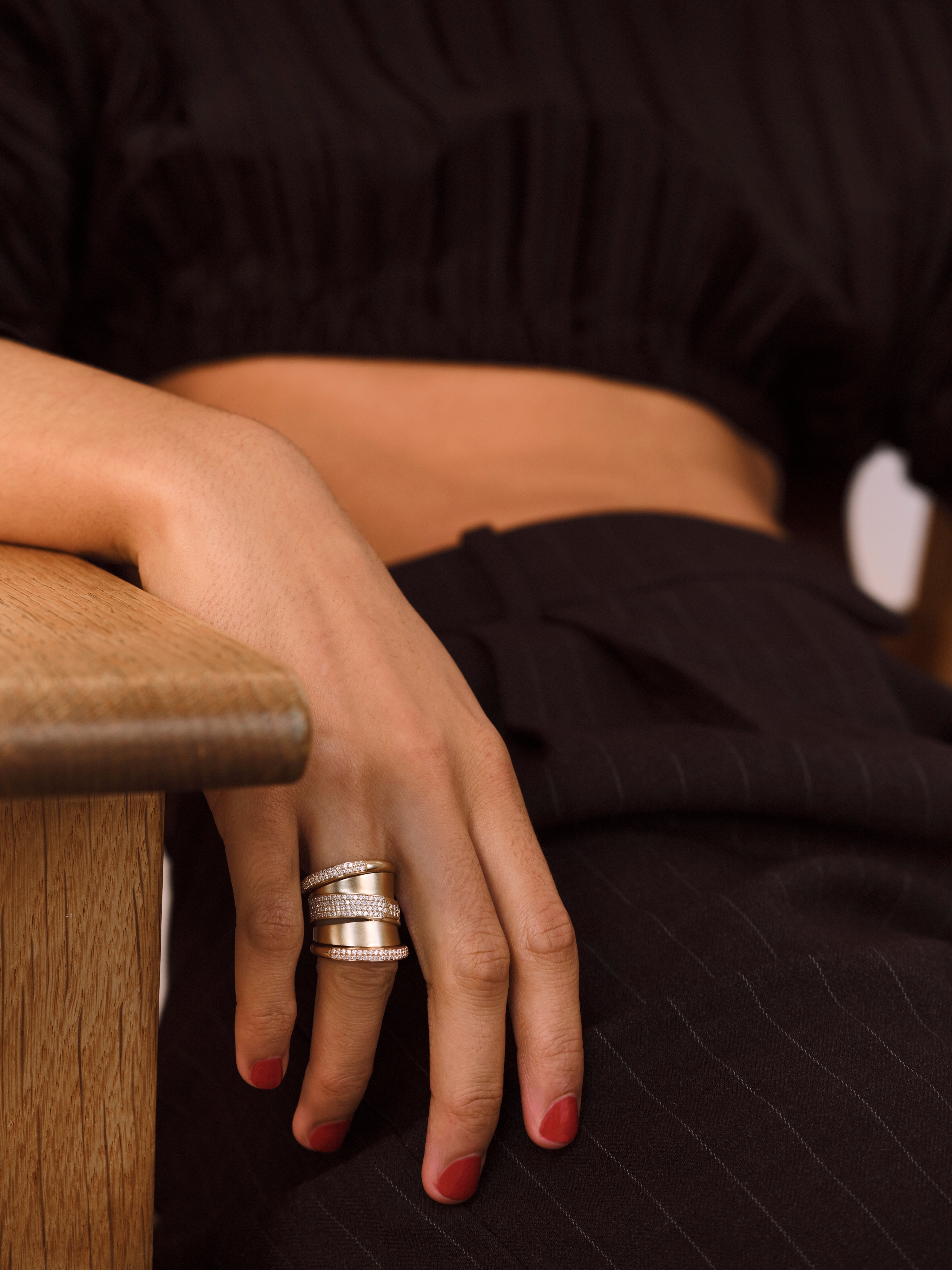
Gold rings run from the quietest wire bands to genuinely sculptural statement pieces. The signet ring has made a proper come back in recent years: originally cut to seal documents in wax, its flat top now suits an engraved initial, a small family crest, or a scattering of tiny diamonds. It stands out as an empowered style statement for both men and women.
If you prefer something quieter, stacking rings and single-stone solitaires never really go out of favour, and both are easy to build on over time. A chunky gold ring with a hammered or high-polish finish brings a bit more presence to an outfit without saying too much. Wearing a ring on the thumb rather than the usual fingers is a look worth knowing about too, if an asymmetric hand stack appeals more than a matched set.
Gold Rings for Women: Styling Tips to Help You Build your Ring Collection
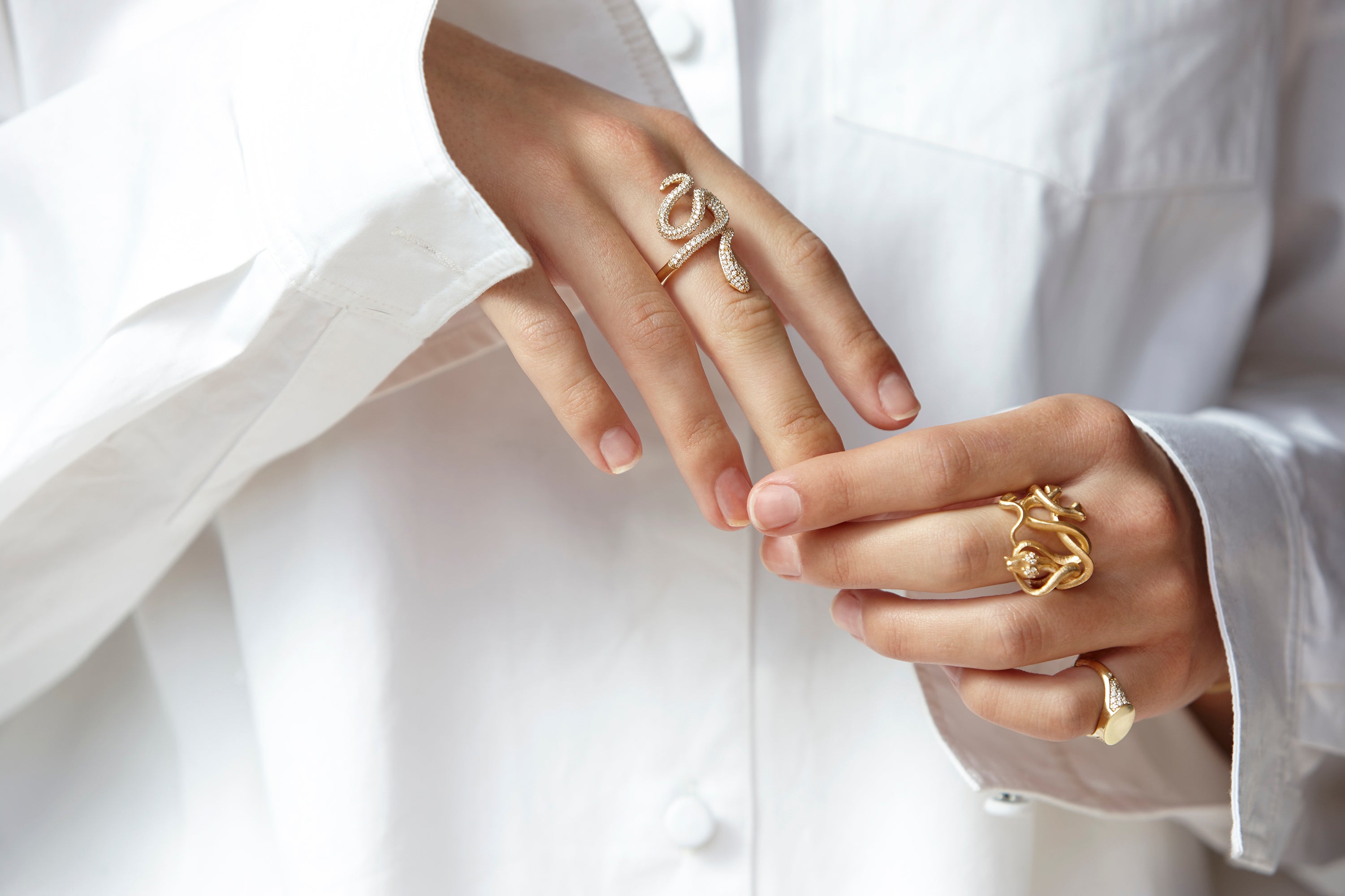
When curating a collection of a gold rings for women, versatility is paramount. Its less about matching and more about range: different textures, different finger placements, gemstones that don't all echo each other. A signet ring worn on the index or pinky finger makes a good anchor point, with slimmer diamond bands sitting on the fingers around it. Mixing something geometric with a softer, hand-shaped form usually looks more like you than a set bought all at once ever does.
An 18k gold ring paired with a brilliant-cut diamond is the kind of piece that moves from a work day into dinner without you having to think about it. A bezel setting suits an active pair of hands, since it protects the stone more than a claw setting can. A claw setting lets in more light and gives more sparkle, at the cost of a little extra exposure to knocks.
Caring for Your Gold Ring
A solid gold ring is genuinely built to last, but daily life, hand cream, washing up, rough surfaces, takes some shine off it over time. A little regular care keeps both the metal and any stone settings looking the way they should. It's worth taking fine gold jewelry off before swimming in chlorinated water or lifting anything heavy, since both put real pressure on the band.
To clean a gold ring at home, soak it for ten to fifteen minutes in lukewarm water with a few drops of mild dish soap, then gently work a soft-bristled toothbrush around the band and under any stone settings. Rinse well and dry with a lint-free cloth. Once a year or so, it's worth having a jeweller check the prongs and polish out any small scuffs that have built up.
Why Choose an Independent Designer?
A ring from an independent designer usually carries more of the maker in it than one from a large factory line, simply because the person designing it is also the one answerable for how well it's made. That tends to show up in the details you'd otherwise miss: an unusual cut of stone, recycled gold, a finish that's clearly been done by hand rather than a machine.
Independent designers also know exactly where their materials come from, because they're often working directly with small foundries and gemstone suppliers rather than a distant supply chain. Choosing one of their rings means buying into a particular goldsmith's way of doing things, not just a finished object off a shelf.
At The Jewellery Room
The Jewellery Room was founded by sisters Charlotte and Pernille Møbjerg as a home for independent fine jewelry designers, chosen for real craft and material honesty rather than how recognisable their name already is.
Selected Designers
Ole Lynggaard Copenhagen: family-run across three generations, still handcrafted in their own workshop north of Copenhagen since 1963. The Elephant and Young Fish collections remain their most loved designs.
Georg Jensen: established in 1904 and one of the true anchoring names in Danish design, still reinterpreting over a century of heritage in silver and 18k gold.
AKIND: a Stockholm studio working with lab-grown diamonds and coloured gemstones, with environmental and ethical sourcing built into how they design from the outset, not added on afterwards.
Why Shop at The Jewellery Room?
Every gold ring on The Jewellery Room has been looked at properly before it's listed, checked for material honesty, design quality and how clearly its sourcing can be traced, rather than added simply to fill out a category.
Delivery is fully insured, pricing is upfront, and warranty support comes straight from the designer who actually made your ring. You are buying directly from independent goldsmiths through one place, with real help on hand if you need it.
Ask Us Anything
Got a question about your piece, your order, or anything in between? We've got answers and if not, we've got real people ready to chat.
What is the difference between a 9k and an 18k gold ring?
A 9k gold ring is 37.5% pure gold, alloyed with harder metals for extra toughness. An 18k gold ring is 75% pure, with a noticeably richer, warmer colour and more actual gold in it. 9k copes better with daily knocks, while 18k tends to sit more comfortably on sensitive skin, since there's less alloy at the surface.
Can I wear a solid gold ring every day?
Yes, and that's exactly what solid gold in 9k, 14k or 18k is built for. Unlike plated jewelry, it won't wear down to a base metal underneath. Clean it now and then, and slip it off before anything physically demanding, and it'll hold up for years.
How should I size a chunky or signet ring?
A wide band, whether it's a chunky style or a signet, covers more of the finger than a thin wire band and can feel tighter as a result, even at the same stated size. Sizing up slightly is often the right call for a wide design, but it depends on the specific piece, so check with the jeweller rather than assuming.
Is 22k gold suitable for an everyday ring?
Not really. 22k gold is 91.7% pure and richly coloured, but noticeably softer than 9k or 18k, so it marks and bends more easily with daily wear. It tends to suit ceremonial or occasional pieces better than a ring you'd put on every morning.
Related guides
-
Read moreChoosing a White Gold Necklace: Material, Chain types, Lengths and Styles
White gold necklace guide: 9k, 14k or 18k, rhodium plating explained, which chain links hold up...
-
Read moreFinding a Gold Bracelet That Lasts: Purity, Fit and Clasp Quality
Gold bracelets that last: compare 9k and 18k for daily wear, check clasp security and wrist...
-
Read moreGuide to Choosing a White Gold Bracelet
White gold bracelet guide: choose between 9k, 14k and 18k, check wrist fit and link strength,...
-
Read moreGuide to Choosing White Gold Earrings
White gold earrings: compare 9k, 14k and 18k, understand rhodium plating and hallmarks, and choose studs,...
Visit our showroom in Copenhagen
Around 15 of our designers are on show at any one time, and you can shop pieces directly from the showroom.
Customer service
Contact
The Jewellery Room ApS
Bredgade 35, 1260
København, Danmark
VAT no. DK32285732
+45 53 69 15 50
customercare@thejewelleryroom.com
Our Room
Every designer in The Jewellery Room is chosen by Pernille & Charlotte, personally. Not because they fit a trend, but because of what they make.
From small ateliers to legacy houses, who makes a piece matters as much as how it's made.
We don't carry everything. We carry what we believe in: pieces made by designers who could have taken shortcuts, and didn't. That's what you'll find here, and we're here to help you choose
Step inside The Jewellery Room,
The Global Home of Designer Jewelry.
social
Copyright © 2026, The Jewellery Room. All rights reserved.


