
By Charlotte Møbjerg, co-founder of The Jewellery Room

How to Choose Diamond Necklaces: A Complete Buying Guide

Choosing a diamond necklace is one of the most rewarding fine jewellery decisions a customer can make — and one of the most straightforward, once the right framework is in place. The short answer: identify the necklace format that suits how you want to wear it, prioritise cut quality on any principal stone, buy certified for stones above 0.5ct, and choose a setting and chain length that work for your actual wardrobe rather than an abstract ideal. The rest of this guide explains how to apply those principles to each necklace type — and what the market does that customers should be aware of before they spend.

Diamond necklaces sit at the most forgiving end of the fine jewellery wear spectrum. Unlike a ring, which contacts surfaces repeatedly throughout the day, or a bracelet, which is in consistent motion against the wrist, a necklace rests against fabric and skin, receives minimal impact, and moves in light in a way that shows a well-cut diamond's performance at its best. That lower-stress context means the same budget goes further in a necklace than in almost any other diamond piece — and it means a diamond necklace is frequently the most practical entry point into fine diamond jewellery for a customer who wants something wearable every day.

For a full account of the four Cs — cut, colour, clarity, carat — and the mined versus lab-grown question in depth, the diamond knowledge guide covers both. If you want that foundation first, start there. If you are ready to make a decision, start here.

What to Look For in Diamond Necklaces

Three things to check before anything else:

- Cut grade on the certificate: Excellent (GIA) or Ideal (AGS) as the minimum for any principal stone

- Whether the stone sits at the correct height in the setting — a pendant that hangs face-forward shows the diamond; one that rotates constantly does not

- Chain length in relation to your neckline and how you typically dress

Cut quality on the principal stone

The principle that applies to all diamond jewellery applies here with particular elegance: the cut grade determines how a diamond performs in light. A well-cut stone captures light through its table facets and returns it as brilliance and fire; a poorly-cut stone allows light to leak through the base, producing a flat appearance regardless of its colour or clarity grade. For a diamond pendant or solitaire necklace — where a single stone is the entire visual proposition, moving gently against the skin throughout the day — cut quality is what separates a piece that catches light constantly from one that does not.

The GIA (Gemological Institute of America) grades cut on a five-point scale from Excellent to Poor; AGS (American Gem Society) uses an Ideal grade at the top of its equivalent scale. Excellent or Ideal cut should be the baseline for any principal stone in a diamond necklace. A G colour, VS2 clarity diamond at Excellent cut will consistently outperform a D colour, VVS1 clarity diamond at Fair cut — not on a grading report, but on the wearer's neck in every light condition, every day.

Three things to check about the chain:

  • Solid metal construction - not hollow or plated
  • Chain gauge appropriate to the pendant weight - a heavy pendant on a fine chain will distort
  • Clasp quality - a spring ring clasp is standard; a lobster clasp offers more security for a significant piece

Stone consistency in multi-stone pieces

For diamond tennis necklaces and pavé necklaces — where many matched stones run continuously across the piece — the quality consideration shifts from individual stone grade to consistency across the full length. Colour, clarity, and size should be visually uniform from end to end. Any variation — a stone that reads slightly warmer or sits at a different level to its neighbours — signals that stone selection was not done with sufficient care. Reputable independent designers match stones deliberately; volume production does not always apply the same standard.

Chain quality

The chain is not incidental to a diamond necklace — it determines how the piece hangs, how it moves, how it wears over time, and whether the pendant sits correctly against the skin. A fine-gauge chain in solid gold or platinum will outlast a plated or hollow chain significantly. For a solitaire pendant in particular, where the chain is the setting's only structural connection between stone and wearer, the chain gauge and clasp quality matter.

Ask whether the chain is solid metal throughout. Hollow chains — lighter and cheaper to produce — compress and kink at stress points over time. A solid cable or rolo chain in 18k gold is the conventional choice for a fine diamond pendant for good reason: it is durable, sits cleanly, and does not distract from the stone.

What to Ask Before You Buy

Ask for the grading certificate on any principal stone above 0.5ct. Ask which laboratory certified it — GIA, IGI (International Gemological Institute), or AGS — and check that the cut grade is specified on the document. A verbal assurance of quality is not the same as a certificate graded independently of the sale.

A note on GIA versus IGI: both use identical grading scales — D to Z for colour, FL (Flawless) to I3 (Included) for clarity, Excellent to Poor for cut. The practical difference is that IGI grades can run approximately one step more generously than GIA. An IGI G/VS2 and a GIA G/VS2 may not represent identical quality. Neither certificate is invalid — IGI is the dominant certification body for lab-grown diamonds and is entirely standard in that context. What matters is that price comparisons across certified stones account for the certifying laboratory.

Ask whether the diamonds are mined or lab-grown. Both are sold through The Jewellery Room with full transparency. The answer should be consistent with the certificate, which specifies origin. Reluctance to answer this directly is worth noting.

Ask about the chain — specifically whether it is solid gold throughout. Is it 18k or 14k? Is the chain included in the price, or sold separately? For a pendant necklace, is the bail (the loop through which the chain passes) soldered closed or open? An open bail can allow a pendant to slide off a chain; a soldered bail cannot.

Ask about the pendant's hang. Does the stone sit face-forward consistently, or does the setting rotate? A pendant with a fixed bail that orients the stone correctly is preferable to one that spins freely, particularly for fancy-cut stones with a directional orientation — a pear or marquise cut that hangs sideways defeats the purpose of the cut.

Ask whether the diamonds have been treated. Standard mined and lab-grown diamonds are not routinely treated. Some lower-quality mined diamonds, however, are fracture-filled or laser-drilled to improve apparent clarity — treatments that affect both durability and value and should always be disclosed. A certificate will note any treatment.

What to Watch Out For

Total carat weight marketed ahead of cut grade. The necklace market, particularly for tennis necklaces and multi-stone pieces, frequently leads with total carat weight — "3ct diamond necklace" — without specifying cut grade, stone count, or individual stone quality. A poorly-cut stone of any carat weight will look flat against the skin. A well-cut stone of half the carat weight will outperform it. Ask about cut grade before total carat weight.

Hollow chains on significant pendants. A hollow chain feels lighter and is less expensive to produce. It also compresses, kinks, and breaks faster than a solid chain under daily wear. For a diamond pendant of meaningful value, a hollow chain is a false economy — the repair or replacement cost will arrive sooner than expected, and in the meantime the chain's behaviour affects how the stone sits and moves.

Pendants that rotate or hang incorrectly. A diamond pendant that spins freely on its bail will spend as much time showing its reverse as its face. This is a detail that is easy to overlook when examining a piece in a retail environment but becomes noticeable immediately in wear. Check how the pendant sits on a chain before purchasing, or ask specifically how the bail is designed to orient the stone.

GIA versus IGI — accounting for the difference. Customers comparing prices across certified stones should note which laboratory issued each certificate. A stone graded G/VS2 by IGI may represent slightly different quality to a stone graded G/VS2 by GIA. This is a market reality worth understanding, not a reason to distrust IGI certificates — particularly for lab-grown, where IGI is the standard.

Chain length described without context. A "princess length" necklace — the industry term for 17 to 19 inches — sits just below the collarbone on most wearers. But that placement varies significantly with the wearer's height, neckline, and build. A chain length described by name alone tells a customer little about where it will actually sit. Ask for the measurement in centimetres or inches, and check it against a chain you already own or a measurement from your collarbone.

Diamond Necklace Types - What to Consider for Each

Three things that matter for solitaire pendants:

  • Cut grade - Excellent or Ideal; the stone performs alone, so this is non-negotiable
  • Bail design - soldered closed, and oriented to hold the stone face-forward
  • Chain weight appropriate to the stone - a very fine chain under a significant stone will not hang cleanly

Diamond solitaire pendants

A single diamond on a fine chain is the purest diamond necklace format — and one of the most consistently wearable pieces in fine jewellery. The stone moves in light throughout the day, sits close to the body, and works with almost every neckline. For a solitaire pendant, cut quality is everything: there is no surrounding metalwork, no halo, no additional stones to add visual weight. The stone performs entirely on its own.

Round brilliant cut is the conventional choice for a solitaire pendant for good reason — it returns the most light across the widest range of angles, which matters for a stone in constant movement. Oval, pear, and cushion cuts are also strong choices for pendants, and the elongated shapes of oval and pear can appear larger face-up than a round brilliant of the same carat weight. Personally, I find the pear cut particularly compelling for a pendant — the point of the stone creates a natural downward orientation that suits the hang of a necklace in a way no other cut quite replicates.

Diamond tennis necklaces

The tennis necklace — a continuous line of matched diamonds set in an articulated metal strip — is the necklace equivalent of the tennis bracelet, and the same quality principles apply: stone consistency across the full length is the defining quality factor, and the clasp mechanism is the structural consideration.

For a tennis necklace, the length at which the piece sits matters for how it reads. A choker-length tennis necklace (14 to 16 inches) sits close to the throat and makes a significant statement. A princess-length piece (17 to 19 inches) falls below the collarbone and has a more fluid, everyday quality. The choice between them is personal, but it is worth considering in relation to the necklines you wear most.

Stone shape in a tennis necklace is also worth considering. Round brilliant is the conventional and most light-efficient choice; emerald-cut or oval stones in a tennis necklace are less common and more individual — they suit customers who want the format but not the standard expression of it.

Three things that matter for tennis necklaces:

  • Stone consistency end to end — colour, clarity, and size matched across the full length
  • Clasp mechanism — a secondary safety catch is advisable for any piece of significant value
  • Length in relation to neckline — where the piece sits changes its entire character

Three things that matter for halo and cluster pendants:

  • Centre stone cut grade - the halo amplifies what the central stone does; it does not compensate for a poor cut
  • Surround stone consistency - size and colour should be matched across the halo
  • Setting construction - how the metalwork between stones is finished determines the quality of the piece's appearance at close range

Diamond pendant necklaces with halos or multi-stone settings

A diamond pendant with a halo — a ring of smaller diamonds surrounding a central stone — or a multi-stone cluster setting is a format that suits customers who want visual impact at a particular price point. The halo creates the impression of a larger centre stone; a cluster creates a different geometry entirely, with multiple stones contributing equally.

For halo settings, the consistency and quality of the surround stones matters as well as the central stone. Inconsistently-sized or poorly-matched stones in the halo are visible, particularly as the piece moves. Ask whether the designer specifies the quality range of the surround stones, not only the centre.

For cluster pendants, the overall design of the setting determines much of the piece's character — how the stones are arranged, how the metalwork sits between them, whether the result is tight and geometric or loose and organic. This is where independent design most distinctly departs from commercial templates.

Diamond letter and initial necklaces

Diamond letter and initial necklaces — pavé-set letters in gold — are among the most personalised diamond necklace formats and among the most consistently popular for gifting. The quality considerations are: the consistency of the pavé work across the letter (stones should be evenly set, no gaps, no protruding claws), the weight and solidity of the metal form (a lightweight letter will not sit cleanly), and the chain gauge.

For gifting, a diamond letter necklace in 18k gold with consistent pavé work is a genuinely considered piece — not a novelty, but a piece with real material value and personal meaning.

Three things that matter for letter necklaces:

  • Pavé consistency - evenly set stones, no visible gaps in the metalwork
  • Metal weight - a solid letter form hangs and sits better than a lightweight one
  • Chain length and gauge - appropriate to the scale of the letter

Layering necklaces with diamond accents

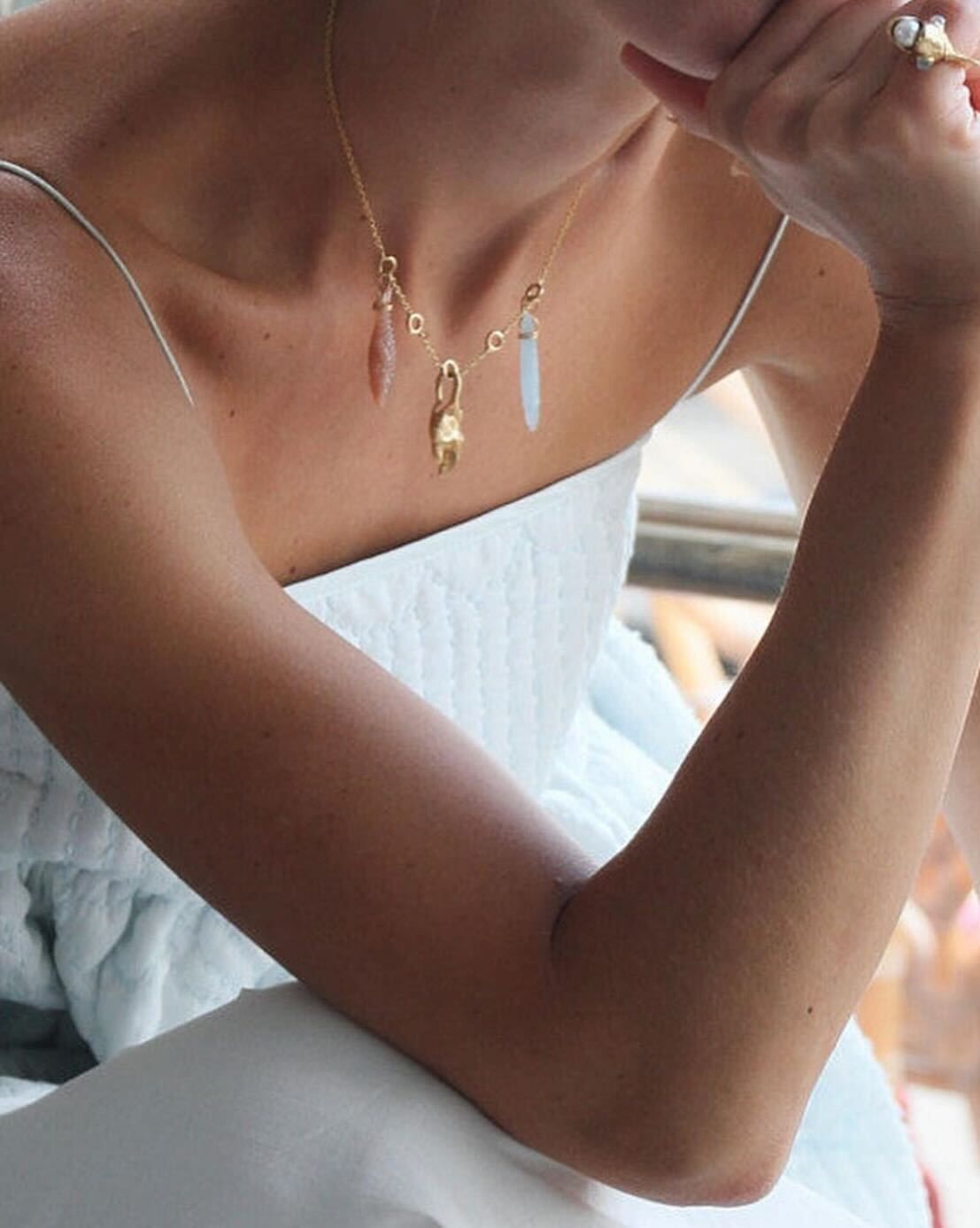
Fine layering necklaces with diamond accents — a single diamond station, a small pavé element, a diamond-set charm — are the most accessible diamond necklace format and the most practical for building a considered necklace stack. The diamond content is modest; the design intelligence is in how the piece layers with others.

For layering pieces, the chain quality is proportionally more important than for a statement pendant — because a layering necklace is worn in combination with other chains, the way it moves, tangles, and sits alongside them is a daily experience. Solid, fine-gauge chains in consistent metals stack more cleanly than mixed constructions.

Why Choose an Independent Designer?

Stone selection is personal, not by specification. A volume retailer sources diamonds to a grade range. An independent designer who works with diamonds selects each stone individually - choosing the specific stone for the specific setting based on how it actually looks, not just how it grades. For a solitaire pendant where the stone performs alone, that difference is immediately visible.

Design intelligence is applied to how the piece is worn. Independent designers think about the bail orientation, the chain gauge, the weight of the pendant against the skin, the way the piece moves. These are decisions that affect how the necklace is experienced daily, and they are decisions that a designer with a specific point of view makes differently to a manufacturer optimising for unit cost.

Transparency is substantiated differently.
An independent designer has a direct relationship with their supply chain. Conflict-free certification, lab-grown origin, recycled metal sourcing - these are commitments a maker can verify and stand behind personally, in a way that differs in character from the general sourcing statements of large commercial operations.

The design reflects something specific.
Heritage houses produce beautifully made versions of their established forms. Volume retailers produce what the current market wants. Independent designers make necklaces because they have something to say about how a diamond should sit against the body, what setting should surround it, and what the piece should mean when it is worn. The result tends to look more considered because it was.

Why Shop at The Jewellery Room?

The Jewellery Room is a curated marketplace for independent jewellery designers. Every designer on the platform has been selected by founders Charlotte and Pernille Møbjerg, who have spent decades in the jewellery industry and apply that experience to the curation. The Jewellery Room does not own the jewellery or control the individual sourcing practices of the designers it features — what it does is make considered decisions about which designers belong on the platform, and stand behind those editorial decisions.

For diamond necklaces specifically:

The selection covers every format. Solitaire pendants, tennis necklaces, halo pieces, letter necklaces, layering chains with diamond accents — the full range of what diamond necklaces can be, from designers who each bring their own design language to the format.

Mined and lab-grown are both represented with transparency. Designers featured on The Jewellery Room work with both mined diamonds — conflict-free certified — and lab-grown diamonds from verified sources. Both are presented with clarity about what each stone is and where it came from.

The price range is genuine. Accessible everyday diamond necklaces from independent designers working in 18k gold sit alongside more significant investment pieces. The curatorial standard applies across the full range.

Our Selection

Diamond Necklaces at The Jewellery Room

Diamond pendants and solitaire necklaces — Single-stone pendants from independent designers across Europe and beyond, in round brilliant and fancy cuts, working in 18k yellow, white, and rose gold.
Browse diamond necklaces →

Diamond tennis necklaces — Continuous-stone necklaces from designers who have applied specific design thinking to stone selection, articulation, and length. The format at its most considered.
Browse tennis necklaces →

Lab-grown diamond necklaces — The full lab-grown diamond necklace selection, for customers who want optical quality and stone size at a meaningfully lower price point, from designers who have made lab-grown their specific focus.
Browse lab-grown diamond jewellery →

VRAI — VRAI's pieces are set in 14k gold with lab-grown diamonds produced in their own zero-emission facility, powered by renewable energy. Note that VRAI works in 14k gold rather than the 18k standard of most designers on the platform — worth knowing when comparing pieces across the selection.
Browse VRAI →

MOH London — Founded by Dakshesh Sangani, who was born into the diamond trade — his father was a diamond cutter, and his understanding of stones comes from the cutter's perspective, not the buyer's. MOH pieces are conceived as objects to be worn daily and understood over time. A strong choice for customers who want a diamond necklace with genuine depth of material thinking behind it.
Browse MOH London →

Christine Hvelplund — A Copenhagen-based designer whose specific expertise is diamonds — every diamond in her pieces is handpicked personally. For customers who want a diamond solitaire or pendant piece chosen with the attention of someone who has built a practice around knowing exactly what they are selecting, Christine Hvelplund's work is worth close attention.
Browse Christine Hvelplund →

Whatever the budget, allocate it to cut quality first, then to stone size. A well-cut 0.5ct solitaire pendant on a solid gold chain will consistently outperform a larger, poorly-cut stone on a hollow chain within the same price range. Diamond necklaces are among the best-value entry points into fine diamond jewellery — the lower wear demands of a necklace mean the piece can be worn daily without the maintenance cycle of a ring, and the same budget produces a more visually impressive stone than it would in a bracelet or ring of equivalent quality.

A diamond solitaire pendant on a solid gold chain is the most practical diamond necklace for daily wear — minimal impact exposure, no setting vulnerabilities that daily contact creates, and a cut diamond that shows its performance constantly in movement and light. A fine layering chain with diamond accent stations is an equally practical option for customers who prefer a more understated look. Tennis necklaces are wearable daily with appropriate care; the clasp mechanism should have a secondary safety catch for any piece of meaningful value.

Ask for the grading certificate on any principal stone above 0.5ct, and check which laboratory issued it — GIA and IGI use the same grading scale, but IGI can grade approximately one step more generously, which matters when comparing prices. Ask whether the diamonds are mined or lab-grown. Ask whether the chain is solid metal throughout or hollow and plated. Ask about the bail — whether it is soldered closed and how it orients the pendant. These are straightforward questions; any reputable seller will answer them specifically.

Independent designers select stones individually rather than by grade specification, which matters particularly for a solitaire pendant where the stone performs entirely alone. They make deliberate decisions about how the piece hangs, how the bail is constructed, and what the chain gauge should be — decisions that affect daily wear in ways that are easy to overlook at point of sale and impossible to ignore afterwards. Their supply chains are direct and verifiable. For a customer who will wear the piece regularly and expects it to represent something considered, the difference is consistently visible.

Princess length — 17 to 19 inches — sits just below the collarbone on most wearers and is the most versatile everyday length. It works with open necklines, sits cleanly under a shirt collar, and layers well with shorter or longer pieces. A choker or collar length (14 to 16 inches) is more specific in its styling demands but makes a stronger statement. Matinee length (20 to 24 inches) falls on the chest and suits lower necklines and layering. The honest answer is that the right length depends on your height, your typical neckline, and how you want the piece to sit — measure against a chain you already own rather than relying on category names alone.

A pendant is an element — a stone, a charm, a symbol — that hangs from a chain. A solitaire necklace specifically features a single principal stone as the pendant element. The terms are often used interchangeably in the market. What matters in practice is the distinction between a piece where a single stone is the entire visual focus (a true solitaire) and one where additional metalwork, a halo, or secondary stones contribute to the design. Both are valid; the choice between them is a question of whether you want the diamond to perform entirely alone or within a designed context.

For a full account of the four quality factors, the mined versus lab-grown question in depth, and what each diamond shape offers, see the diamond knowledge guide.

For detailed guides on each quality factor: diamond cut · diamond colour · diamond clarity · diamond carat